
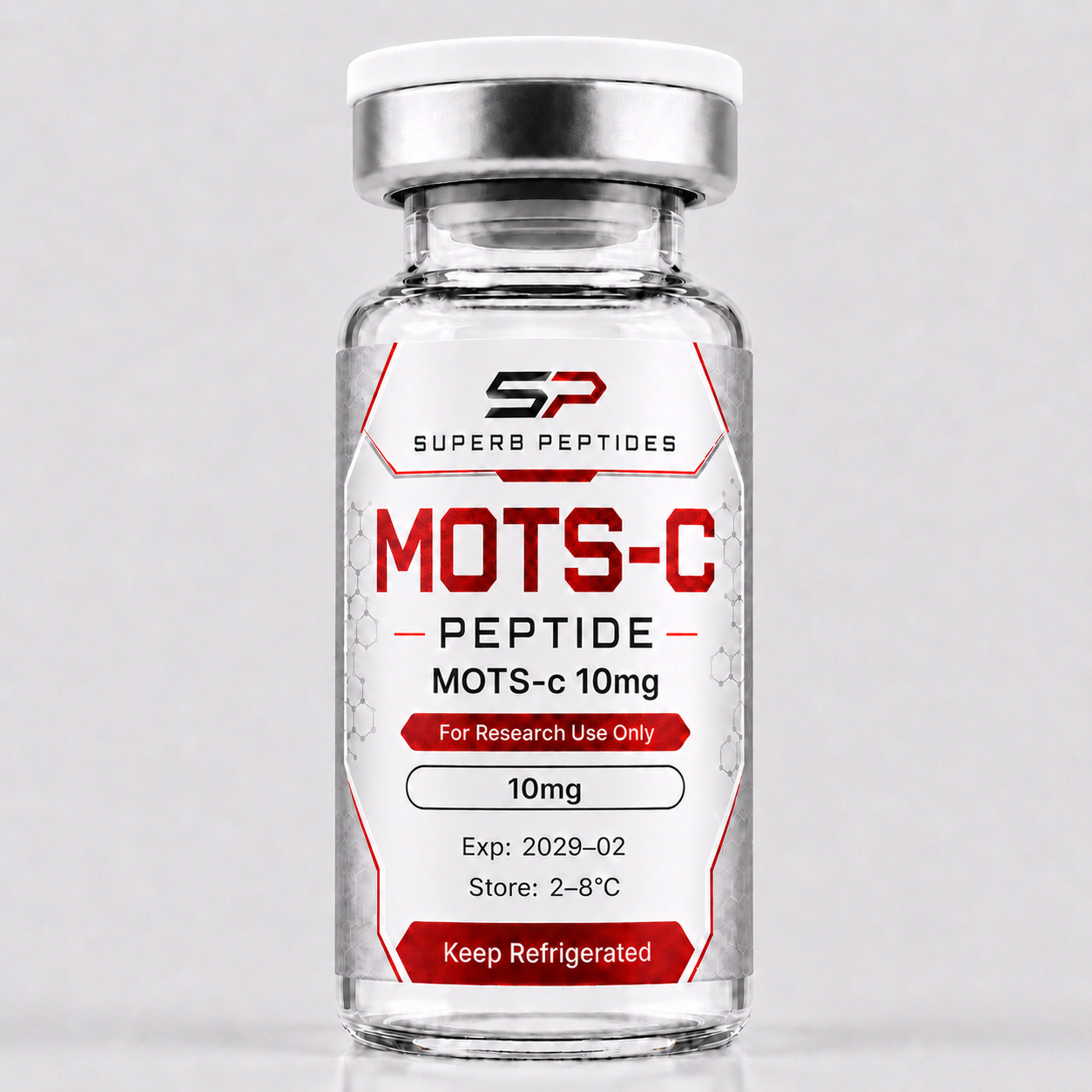
CAT. SP-MOTSC-10
Research Use Only
≈ 2 174 Da
 01 · Vial02 · Label03 · Packaging
N° 001Catalog Entry
MOTS-c
Mitochondrial Open Reading Frame of 12S rRNA-c
★★★★★Be the first to reviewMitochondrial peptide studied in the AMPK energy pathway
Third-party report pending
An independent lab report for this compound is not published yet. We add it the day it arrives, and never borrow a result from another compound. See our lab results
$60.00CAD · 10 mg / vial
1
Research-use-only catalog item supplied for laboratory identification and research purposes. Not for human consumption.
How ordering works
- 1Place your orderCheck out with your shipping details. Your order is reserved right away.
- 2Pay by e-Transfer or BitcoinExact payment details appear on screen and in your confirmation email.
- 3We confirm and dispatchOnce payment lands we ship by Canada Post, Monday to Wednesday.
- 4Track your parcelTracked orders get a Canada Post tracking number by email.
Unpaid orders are released after 72 hours. More in the FAQ
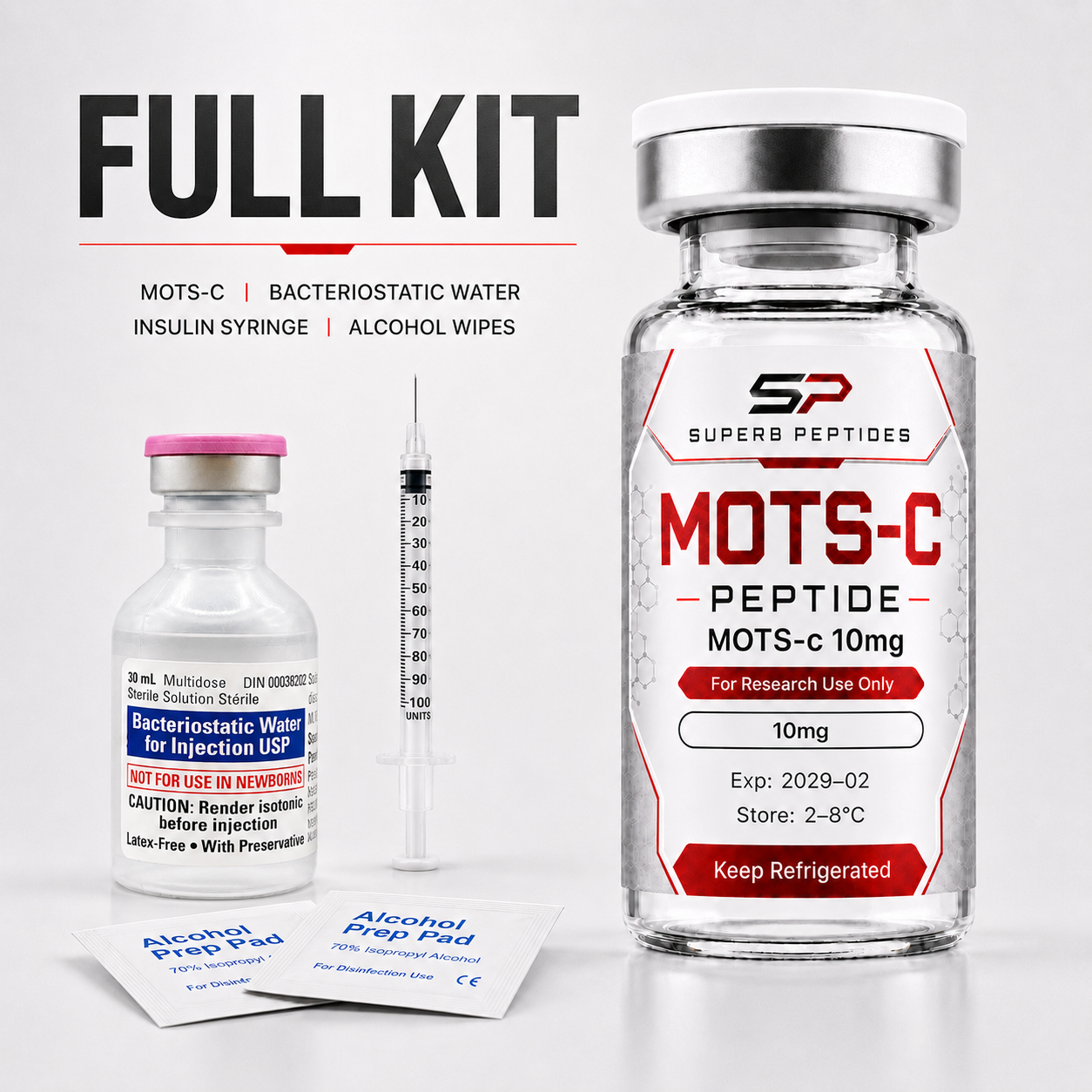 Need supplies too? Add the MOTS-c Starter Kitplus bacteriostatic water, syringes, and alcohol pads for just +$30View →
●Ships across Canada. We dispatch Monday to Wednesday by Canada Post, and most orders arrive in 1 to 6 business days depending on region. Free shipping over $300.
●Interac e-Transfer or Bitcoin. Pay in CAD, or save 5% with crypto.
●Storage. 2 to 8°C, protect from light.
●All sales final. No returns or exchanges. Damaged or lost shipments are replaced at our cost.
Description
MOTS-c is a 16-amino-acid peptide encoded in mitochondrial DNA rather than in the cell nucleus. It is used in laboratory work on cellular energy pathways, including AMPK signaling, skeletal muscle metabolism and mitochondrial research models. Supplied as a lyophilized powder, strictly for laboratory research and analytical use.
Intended use · In-vitro laboratory research only. Not for human or animal consumption, and not for clinical, diagnostic, cosmetic or personal use.
N° 002 · How It Works
How MOTS-c works.
MOTS-c is unusual because it is coded in mitochondrial DNA rather than in the cell nucleus. In cell and animal studies it acts mainly on skeletal muscle, where it interferes with the folate cycle. That builds up a molecule called AICAR, which switches on AMPK, the cell's main energy sensor. Under stress, MOTS-c also moves into the nucleus and changes which genes are switched on. Researchers use it to study how mitochondria signal to the rest of the cell, and how that changes with exercise and age.
Studies referenced
- 1.Lee C, Zeng J, Drew BG, et al. (2015). The mitochondrial-derived peptide MOTS-c promotes metabolic homeostasis and reduces obesity and insulin resistance. Cell Metab. PubMed 25738459 · doi:10.1016/j.cmet.2015.02.009
- 2.Kim KH, Son JM, Benayoun BA, et al. (2018). The Mitochondrial-Encoded Peptide MOTS-c Translocates to the Nucleus to Regulate Nuclear Gene Expression in Response to Metabolic Stress. Cell Metab. PubMed 29983246 · doi:10.1016/j.cmet.2018.06.008
- 3.Reynolds JC, Lai RW, Woodhead JST, et al. (2021). MOTS-c is an exercise-induced mitochondrial-encoded regulator of age-dependent physical decline and muscle homeostasis. Nat Commun. PubMed 33473109 · doi:10.1038/s41467-020-20790-0
These are the studies behind the summary above. They describe laboratory, animal or clinical research, not this product.
N° 003 · Research Areas
What researchers study MOTS-c for.
Areas where MOTS-c shows up in published research. Listed for context only. We don't give dosing or human-use guidance.
- 01Insulin sensitivity in muscle cells
- 02Exercise and metabolic adaptation
- 03Mitochondrial function and ageing
- 04Fat tissue energy balance
N° 004 · Specifications
Product specifications.
The molecular details for this compound.
Molecular Spec Sheet
Edition · 2026
- Catalog ID
- SP-MOTSC-10
- Molecular Weight
- ≈ 2 174 Da
- Empirical Formula
- C100H152N28O22S2
- Sequence
- MRWQEMGYIFYPRKLR
- Sequence Note
- 16 residues, mitochondrial-encoded
- Storage
- 2 to 8°C, protect from light
- Intended Use
- Laboratory research only
N° 005 · Lab Handling
Reconstitution & storage notes.
- 01Reconstitute in sterile water at desired working concentration
- 02Aliquot and freeze at −20°C for long-term storage
- 03Avoid repeat freeze and thaw cycles
All products are intended strictly for laboratory research use only. Not for human consumption. Not for medical, diagnostic, therapeutic, veterinary, or household use. Product information is provided for research identification and catalog purposes only.
N° 006 · Related
More from the catalog.
Researcher Reviews
No reviews yet. Be the first.